Shallow Graves and Marked Stones
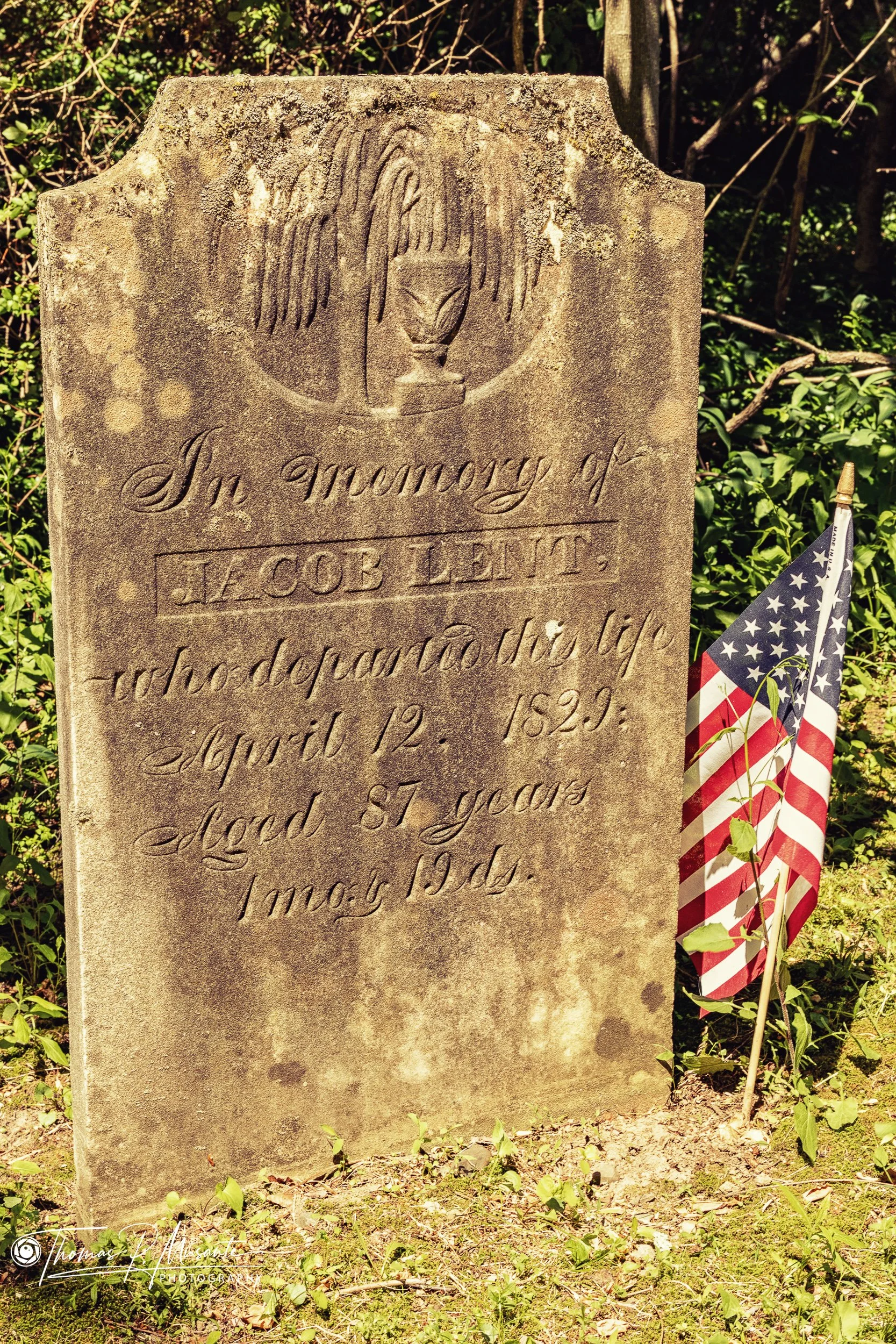
The headstone of Jacob Lent, carved with a willow and urn, stands with a small American flag placed at its base. Tomahawk Chapel Cemetery, Somers, New York. Rev250 living history photography by Thomas Musante
Tomahawk Chapel Cemetery is about ten minutes from my house. I have driven past it more times than I can count, and it took me most of a year of this project to actually stop.
Private Jacob Lent of the Westchester County Militia, 3rd Regiment, is buried there — I wrote about him in a previous post. A local farmer who served in one of the war's most contested regions, he was eighty-seven when he died. The stone is still legible. You can stand in front of it and read his name without effort, which is a small thing and also the entire point — because the great majority of the men who died in this war got nothing like it.
The Picture We Hold
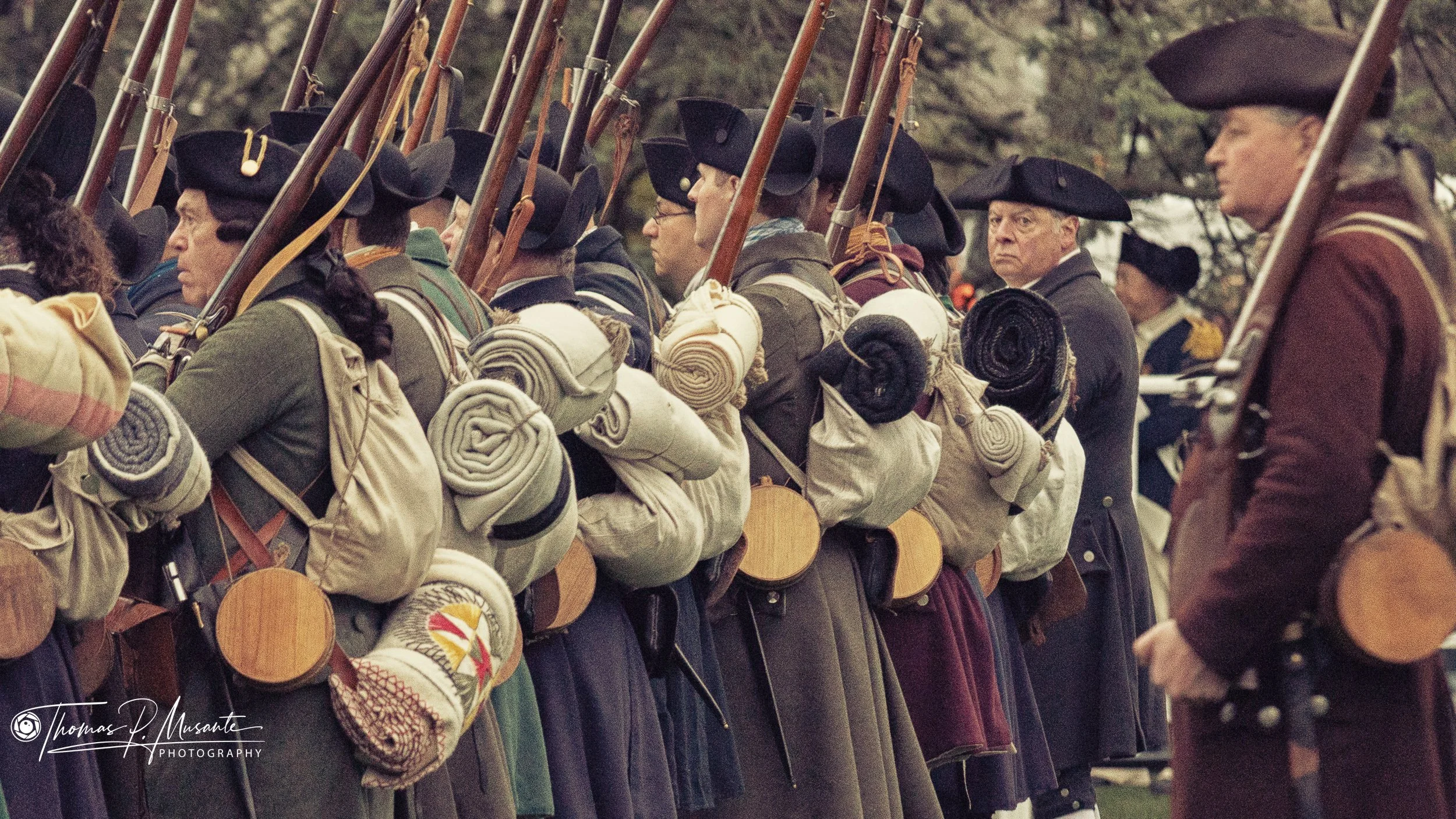
Every Man Here Has a Name. Rev250 living history photography by Thomas Musante.
The picture most of us carry of the Revolutionary dead is a Lexington picture: ordinary men falling a few steps from their own doors, in front of people who knew their names.
On the morning of April 19, 1775, Jonas Parker of Lexington stood his ground on the Green after the first volley. Wounded by a British musket ball, he was finished with a bayonet while still on the ground. Lexington remembers him as among the first to fall in the war, though the ordering of those opening minutes has never been fully recoverable.
Nearby, Jonathan Harrington Jr. was struck down in the same volley and dragged himself across the road to the doorstep of his own house. By long Lexington tradition his wife watched from the window and reached him as he died on the step. The house still faces the Green today. I have stood in front of it, and the distance is short enough to walk in under a minute — which is somehow worse, not better.
That is the first morning of the war, and it is very nearly the last time it looked like that. Almost everything after Lexington happened somewhere else, to men who had marched a long way from home, among strangers, and who went into the ground without anyone writing down where.
The Work After the Smoke
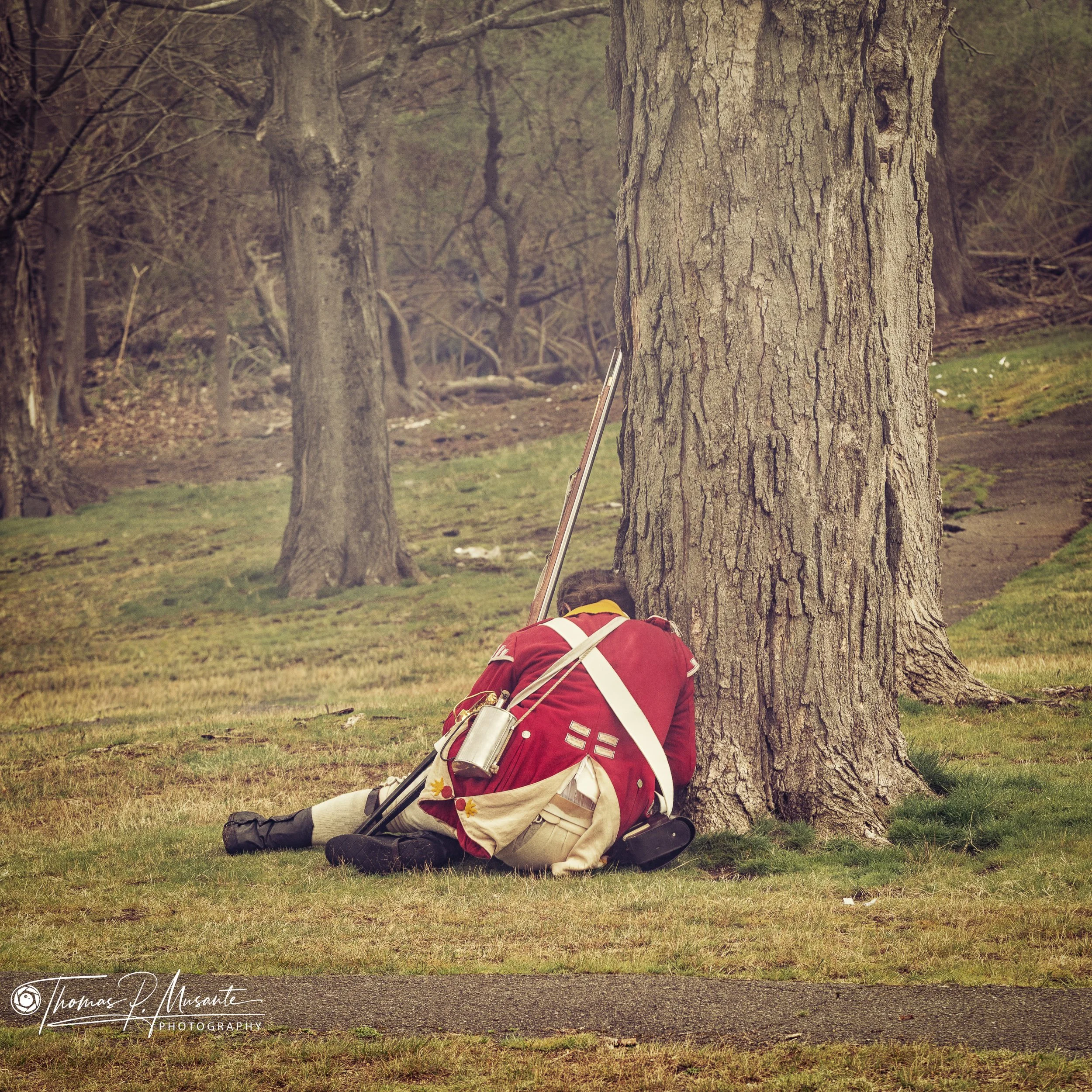
A fallen British regular lies against the base of a tree, a musket propped on the trunk beside him, Lexington, Massachusetts. Rev250 living history photography by Thomas Musante.
The same pattern repeated wherever the fighting stopped. After the smoke cleared, the living faced a task that was both practical and terrible. Bodies had to be moved before they became a greater danger than the enemy. Clothing and equipment that could still serve the army were taken. Officers might receive a more careful burial if time and the situation allowed; the rank and file rarely did. Most were placed in shallow pits or common trenches dug close to where they had fallen. In many cases the work was finished the same day or the next morning so the army could march on.
The side that held the field usually directed the work, burying both its own dead and the enemy's. Local residents often assisted or finished the task once the troops had gone. Along the Battle Road after April 19, townspeople and farm families buried a number of the British soldiers left behind. Lincoln tradition holds that when five regulars killed in the fighting near Hartwell Tavern were carried to the town burying ground, Elizabeth Hartwell insisted they be laid in her own family plot. The five are there — the town raised a stone over them in 1884. Whether the insistence was hers is the kind of thing that survives as family lore rather than as record. But somebody made that choice, and it was not the obvious one.
The same necessity — speed over ceremony, utility over permanence — governed later fields from Ridgefield to Camden. The ground itself became the first and often the only marker.
The Greater Killer

A woman cries over the body of a smallpox victim, Fort Ticonderoga, Return of an Army July 2026, Rev250 living history photography by Thomas Musante.
Disease did more of the work than the muskets did. For every soldier who fell to a ball or a bayonet, several more died of camp fever, dysentery, or smallpox in crowded hospitals and winter quarters.
The recovery and reinterment at Lake George makes that reality tangible again. In February 2019, a construction excavation on Courtland Street in the village turned up human remains — first in the disturbed soil, then in undisturbed ground beside it. Over the next two years, more than a hundred volunteers sorted the excavated stockpile by hand. What they had found was a cemetery attached to the Continental Army's smallpox hospital, established at Fort George in 1776 as the army fell back from Quebec. Several thousand sick men passed through that hospital. As many as a thousand of them died there. The forty-four sets of remains pulled out of Courtland Street are a fraction of that number, and most of them were young.
On May 20, 2026, a motorcade carried them sixty miles from the New York State Museum in Albany up Route 9 to Lake George. People stood along the road for the whole run. Two days later they were reinterred at Lake George Battlefield Park under a memorial called Repose of the Fallen, and living historians in period dress carried the caskets to the graves — which is the plainest statement of what this work is for that I have come across all year.
In July, button evidence tied at least some of the Lake George men to the First Pennsylvania Battalion. Buttons keep doing this. Buttons under the house in Ridgefield, buttons in the trench at Camden, buttons at Fort George. Two hundred and fifty years on, a scrap of cast pewter is often the only thing left that still knows who someone was.
The same quiet toll shows up in the reenactment record, and it is the reason I keep coming back to these fields with a camera. At Fort Ticonderoga this summer I photographed a woman sitting beside the body of her husband, dead of the pox. Nobody was performing for me. She was absorbed in something she had chosen, and I stayed at distance and made one frame. It is a restrained picture, and it carries the weight of thousands of similar deaths that no one recorded at all. Those men rarely received marked graves. Their names, when they survive, survive in hospital records and pension files rather than on headstones.
What the Ground Is Giving Back
In the last several years, archaeology and forensic science have begun to pull some of these men back into view.
In 2019, construction under an eighteenth-century house on Main Street in Ridgefield, Connecticut, uncovered a communal shallow grave holding the remains of four robust young men. Buttons were found with some of them. The site lies on or near the main engagement of the April 1777 battle. Forensic work continues, but the evidence strongly suggests these were combatants buried hastily after the fighting — which is to say, buried exactly as the pattern predicts, and then paved over and forgotten for two hundred and forty years.
Farther south, at the Camden battlefield in South Carolina, archaeologists recovered fourteen sets of remains in the fall of 2022 — twelve Continentals of the Maryland or Delaware line, one likely a North Carolina Loyalist, one from the British 71st Regiment of Foot. Buttons and grave position did most of the identifying. Some of the men were less than six inches down. In April 2023 all fourteen were reinterred on the battlefield with military honors.
In June 2026, forensic genetic genealogy put a name to one of them. Camden 9B was Private John Pumphrey of the 7th Maryland Regiment — orphaned at ten, enlisted at Baltimore in 1777 somewhere between thirteen and fifteen years old, signing his papers with an X because he had never learned to write his name. Brandywine, Germantown, Monmouth, Valley Forge. He re-enlisted in 1779 for a hundred dollars. He had marched something over a thousand miles by the time the army broke at Camden in August 1780, and afterward he was listed as missing. He is described as the first Revolutionary War soldier identified this way. What killed him is not known; there was no wound on the bone.
Camden is far outside the ground I usually work. I include it for what happened after: this June, Pumphrey's genetic relatives gathered in Maryland for a boy who died two hundred and forty-six years ago and whom none of them had ever heard of. He was tipped into a grave inches deep in 1780. He has his name back, and a family standing in a room for him. That is not a small thing, and it is not finished.
None of this is new. Through the nineteenth century, as churchyards filled or were cleared for city growth, families and towns regularly moved their veterans to better ground. The same desire runs from the hasty pits of the 1770s straight to the labs — gather the dead, name them where you can, put them somewhere marked.
The Stones That Are Still Legible

The headstone of Isaac Hastings and his wife Sarah, its inscription naming him among the patriots who resisted the British on Lexington Common. Old Burying Ground, Lexington, Massachusetts. Rev250 living history photography by Thomas Musante.
Closer to home, individual names and ordinary lives remain visible.
Isaac Hastings was nineteen on the morning of April 19, 1775, and he stood on the Common with his father and his brother. All three walked off it. Five of the eight father-and-son pairs on the Green that morning were broken by a death.
He lived another fifty-five years. In September 1824, when Lafayette came through Lexington on his farewell tour, Hastings was one of fourteen survivors of the Common still alive to meet him. He died in 1830 at seventy-five. His stone in the Old Burying Ground names him as one of the patriots who resisted the British troops that morning, and you can still read it.
So can Jacob Lent's, ten minutes from my house.
That is what separates them from the four men under the house in Ridgefield and the fourteen in the Camden trench — not courage, not service, not anything they did. Only luck, and the fact that somebody was there afterward to cut a name into stone.
Two hundred and fifty years on, the work of remembering is still going. It is in the recovery teams and the DNA labs. It is in a woman sitting beside a man who died of the pox, in July, because she thought the moment was worth holding. And it is in the plain act of standing in a small Somers cemetery and reading a name off a stone — the closest thing I have found to the reason this project exists. Some of these men fell steps from their own doors. Others died far from home in crowded hospitals. Where we can, we know their names. What we choose to do with them still matters.
Somers, New York
If you liked this post, check out:
Sources
Jonas Parker and Jonathan Harrington: Elias Phinney, History of the Battle at Lexington (1825); Lexington Historical Society; subsequent local compilations. Note that Phinney is a partisan source in the Lexington/Concord priority dispute and the sequence of the first casualties is not firmly established.
British burials along Battle Road: National Park Service, Minute Man National Historical Park; Freedom's Way National Heritage Area, "British Revolutionary War Soldiers' Gravesites." The Elizabeth Hartwell account is recorded as local tradition rather than documented record.
Lake George recovery and reinterment: Courtland Street Reinterment Committee, "Repose of the Fallen," reposeofthefallenlg.org; New York State Museum; Times Union and Lake George Examiner coverage, 2026. First Pennsylvania Battalion attribution reported by The Daily Item (Sunbury, PA), July 2026.
Ridgefield remains: Connecticut Office of State Archaeology; Ridgefield Historical Society reports, 2019–2026.
Camden excavation and reinterment: South Carolina Institute of Archaeology and Anthropology (Steven D. Smith and James Legg, principal investigators); South Carolina Battleground Preservation Trust, November 2022 announcement; South Carolina Executive Order 2023-10.
John Pumphrey identification: University of South Carolina, McCausland College of Arts and Sciences, July 2026; FHD Forensics (Allison Peacock); Maryland State Archives; NPR, Smithsonian, CBS News, and Associated Press coverage, June–July 2026.
Isaac Hastings: Ken Shine and Bill Poole, "Isaac Hastings: A Brief Biography," Lexington Minute Men (lexingtonminutemen.com), drawing on Charles Hudson's History of the Town of Lexington, Massachusetts Soldiers and Sailors of the Revolutionary War, Vincent Kehoe's We Were There, and Francis H. Brown's Lexington Epitaphs (1905)